Showing posts with label books. Show all posts

4.18.2007

What Kind of Person am I?

I’m reading a book right now called The Divine Conspiracy by Dallas Willard, a philosophy professor at the University of Southern California and a Christian.

I gotta tell you, this book has been pushing me and challenging me theologically more than the past ten books I’ve read combined! And I’ll tell you why.

The Divine Conspiracy focuses largely on The Sermon on the Mount, Jesus’ teaching in Matthew 5 and 6. Most of the time, when we read these teachings of Jesus—teachings like: do not be angry, do not lust, do not swear an oath, love your enemies, etc., etc., etc.—when we read these, we assume that Jesus is giving us laws to obey. But Willard argues that these are not laws; these are illustrations of how a certain kind of person lives.

And what kind of person is this? A person whose life is completely submitted to God. A person who lives and breathes the life of God. A person whose feet are covered with the dust kicked up by Jesus’ feet because they are following so closely.

This kind of person does not simply obey a law that says “do not be angry with your brother or sister” (and, by the way, Jesus doesn’t exactly say this, but this is how we often understand Matthew 5:21-22). The kind of person that Jesus is talking about does not get angry or bitter because their life is filled with the love of God.

This kind of person does not simply obey a law that says “do not lust” (again, not exactly how Jesus put it). This kind of person will not objectify anyone sexually because they understand a person’s value the way God understands a person’s value.

This kind of person will not merely obey a law that says “do not swear.” This kind of person will be a person of integrity and honesty; a person who does not need to swear or promise or make an oath because this person always means what he or she says—and follows through.

I hope this makes sense. I’m still learning to grasp this way of reading Jesus’ words. And I’m struggling with this question: “Am I that kind of person? Or am I just trying to obey what I think are the rules?”

Let me end with these two paragraphs from The Divine Conspiracy:

Is it then hard to do the things with which Jesus illustrates the kingdom heart of love? Or the things Paul says love does? It is very hard indeed if you have not been substantially transformed in the depths of your being, in the intricacies of your thoughts, feelings, assurances, and dispositions, in such a way that you are permeated with love. Once that happens, then it is not hard. What would be hard would be to act the way you acted before.

When Jesus hung on the cross and prayed, “Father, forgive them because they do not understand what they are doing,” that was not hard for him. What would have been hard for him would have been to curse his enemies and spew forth vileness and evil upon everyone, God and the world…. He calls us to impart himself to us. He does not call us to do what he did, but to be as he was, permeated with love. Then the doing of what he did and said becomes the natural expression of who we are in him.

3.23.2007

Real Reality

I'm reading a book right now by Chuck Palahniuk called Haunted, a strange story about a bunch of writers who have gone on a retreat, only to find themselves locked in an old theater with no windows, limited food, and no way out.

Sounds kind of disturbing, doesn't it? Well, it is kind of disturbing. But then, Chuck Palahniuk is known for writing on disturbing subject matter--he's best knows for writing the book, Fight Club, on which the movie of the same title is based.

So, why am I reading this book? Because I like disturbing subject matter? Not really.

I'm reading Haunted (aside from the fact that's it's an engaging book) because I believe Chuck Palahniuk is a window into the world of our culture, especially the world of Generation X and younger. A world filled with despair and hopelessness. A world that is desperately searching for meaning beyond itself. A world that wants more to life than just wealth and good looks.

The book itself is made up of short stories "written by" the writers who are stuck in the old theater.

Last night, I read a story called The Nightmare Box, in which a young woman looks into an antique box called a Nightmare Box. The Box itself continously ticks (like a clock), and then at some random point stops ticking. When it stops ticking, the first person to look into the box sees something that drives that person to utter despair.

What is it that people see in the Nightmare Box? What could be that terrible, that awful, that horrifying?

By the end of the story, we learn what the Nightmare Box reveals:

It's something that goes beyond life-after-death. What's in the box is proof that what we call life isn't. Our world is a dream. Infinitely fake. A nightmare.

One look, Rand says, and your life--your preening and struggle and worry--it's all pointless....

All your problems and love affairs.

They're an illusion.

"What you see inside the box," Rand says, "is a glimpse of real reality."

I don't know about you, but I see truth in these words. When we understand "real reality" we discover that all our "preening and struggle and worry--it's all pointless."

But what's "real reality"? If we caught a glimpse of "real reality," would it really lead to despair? Or would it lead to hope?

I'm also reading another book right now, this one by Dallas Willard, called The Divine Conspiracy. In this book, Willard delves into the meaning of the Sermon on the Mount (or, as he calls it, the Discourse on the Hill).

In his chapter on the Beatitudes, Willard challenges the common notion that the Beatitudes are instructions on how to live. When Jesus says "Blessed are the poor in spirit, for theirs is the kingdom of heaven," Jesus isn't instructing us to be "poor in spirit." Jesus isn't saying it's a virtue to be "poor in spirit."

On the contrary, Jesus is saying that the "real reality" is that those who are "poor in spirit," those who are "spiritually bankrupt, deprived and deficient, the spiritual beggars, those without a wisp of 'religion'"--theirs is the kingdom of heaven!

Here's how Willard puts it:

Those poor in spirit are called "blessed" by Jesus, not because they are in a meritorious condition, but because, precisely in spite of and in the midst of their ever so deplorable condtion, the rule of the heavens has moved redemptively upon and through them by the grace of Christ. (italics Willard's)
See, that's "real reality"! Jesus has brought into the world a new "real reality." A reality in which the kingdom of heaven is here! Among us. With us. In Jesus.

We are living in the midst of the kingdom of heaven because Jesus has brought it near. And all can experience that "real reality" because of the grace of Jesus.

So here's the question: Would the Nightmare Box really lead a person to utter despair?

I don't think so. Not if it revealed the "real reality" that Jesus revealed.

3.03.2007

A Christian, an Atheist, and a Freebie

First, I promise I'll finish the Launch Conference posts real soon. I feel bad that it's taken so long, but I promise it'll be done soon.

Now then... Last year I read a book called A.K.A. Lost by Jim Henderson, a book that questions the way evangelism has typically been done in the past 50 or so years. Jim Henderson also organized the Revolution Conference last fall that D.G. and I attended.

Aaron Klinefelter just informed me about a new book by Jim Henderson and Matt Caspar called Jim and Caspar Go to Church. The tag-line hints at the book's premise: A believer, an atheist, an unlikely friendship...

Here's the basic idea...

Jim Henderson is a Christian. Matt Caspar is an atheist. And together they visit 10 churches, including Willow Creek, Saddleback, The Potter's House, and other smaller churches. Then they offer their thoughts.

Sounds like a really interesting book to me!!

Here's the freebie.... Follow this link and you can read the first chapter of the book!

1.21.2007

Church-leaving and Church-planting

So here's what's going on in my life.

I'm the Associate Pastor at Union Presbyterian Church, working primarily with the youth ministry. But you already knew that (some of you, anyway). Last May our Senior Pastor resigned, leaving me as the only pastor on staff. It was challenging, but also a time of significant personal growth for me. While I didn't hold the title, "Head of Staff," I essentially served in that role. In that time, I grew in confidence in my ability and calling to serve a church as the lead pastor.

In August, I told our Session (our governing board) that I'd be willing to consider serving as UPC's Interim Pastor. The Session was in favor of it, but the Presbytery (the regional governing body) said they wouldn't approve that. They suggested it would be good for someone to come in from the outside to help the church work through some of its history and challenges.

And I can definitely see the value in that.

Add to all this the fact that our church is having a tough time financially and can now afford to keep only one pastor. Since I couldn't stay on as Interim Pastor, that meant that I would have to leave this church.

Well, at that point, it became clear that God was carving out a new path for me and my family. So, I started looking for a new position, looking primarily for Head of Staff positions.

In the past year, I've begun to develop an interest in church planting, so, in addition to seeking positions at established churches, I also submitted my resume to presbyteries that are starting new churches.

So, here's what has happened with all of that. I've been in touch with two churches over the past several months (one of them more seriously in the past couple weeks). One is a New Church Development (that's what us Presbyterians call a church plant); the other is an established congregation. Both have their pros and cons. Both will be challenging. Both, I believe, will be rewarding. Both--including the established church--are looking for someone with an interest in church planting.

And I'm waiting to see what happens--circling the destination, so to speak, waiting for my clearance to land. Except I'm not sure which one is my destination. Come to think of it, it's totally possible that neither of these is my destination. In any case, I'm waiting--waiting for God to say, "Go!" And when he does, I'll go.

At this moment, I'm lying on my bed in my hotel room in New York City with my laptop on top of my lap, watching Firewall on HBO (man, intense movie!). Tomorrow I walk down the street to attend The Launch Conference: Starting a New Church from Scratch. (The guys doing this conference have got some pretty good, practical podcasts on their site. Check them out here.)

I'm really looking forward to what I'll learn at this conference--regardless of whether I end up in a New Church Development or an established church. As a shrinking denomination, I believe the PC(USA) needs church planters. I believe it needs new churches and it needs renewed churches.

So, anyway, that's what's going on right now. I'll let you know how the conference goes.

Oh, yeah--one more thing. I just started reading Blue Like Jazz, by Donald Miller. I've heard good things about this book. I've heard bad things. The flight attendant on my first leg today told me it was a great book. My friend, Ted, on the other hand, felt differently. Check out his thoughts here. In all honesty, I love it so far!

12.31.2006

Velvet Elvis Complete

Well, I finally finished reading Velvet Elvis. I know... some of you are wondering, "What took you so long?! The book's not that long!"

Ok, I was supposed to be reading it together with some friends who shall remain nameless (Chad and Wes), but whenever we got together to discuss the book, we never really discussed the book.

Don't get me wrong. We had great conversations--and many of them were deeply theological--they just didn't focus specifically on the book. So, I took my time reading the book, waiting to see if we were gonna discuss the chapters we had read.

Never happened. Or more accurately, rarely happened.

I got to the point where I just wanted to finish the book, and that's what I did a couple days ago.

I know that I've been a little hard on Rob Bell in the past (mostly in terms of how he comes across), but I have to admit that his theology really resonates with me. I've been listening to his sermons on the Mars Hill website and I'm always enlightened and/or convicted by the time I'm done listening.

While I don't necessarily want to be another Rob Bell, I do hope and pray that my own faith would continue to grow in the direction that God seems to be taking it--namely in the direction of truly living out the Gospel of Jesus not only in word, but also in deed. That is, in the way that I live my life in the world as a follower of Jesus. (Check out Ted's post for more of this in regard to Rob Bell.)

Thanks, Rob, for challenging me in that direction.

10.31.2006

I'm currently reading...

I usually appreciate knowing in advance whether a book is worth reading or not, and the only way to find out is to ask someone who has already read it. So I thought I'd start publishing what books "I'm currently reading..." in the sidebar. That way if anyone out there is curious if these books are worthwhile or not, just ask...

10.27.2006

Attention Blogging Pastors

Just something quick. Brian Bailey, who just finished writing The Blogging Church (due out in January), is keeping a list of pastors who blog. If you're a blogging pastor, you can get on the list by e-mailing Brian (his e-mail address is at the top of the page).

10.25.2006

The Missional Matrix

So, I'm reading Breaking the Missional Code by Ed Stetzer and David Putnam right now (yeah, I'm reading Velvet Elvis, too; and believe it or not, I'm also reading Olympos, some good sci-fi by Dan Simmons before bedtime each night!) and the book makes some pretty interesting observations, including some thoughts regarding George Barna's "revolutionaries."

I haven't read Barna's book, but I'm going to the Revolution Conference with D.G. Hollums next week, so I'm curious to see what I learn there and how it compares to Stetzer and Putnam's analysis.

Here's their analysis in brief. I'm including the diagrams from the book which will hopefully help keep this as clear as possible.

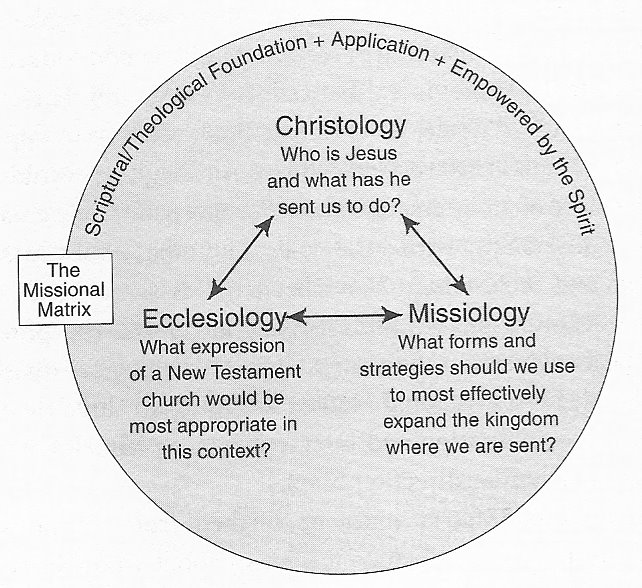
First of all, for a church to be truly missional, it has to include a healthy balance of three things: christology (Who is Jesus and what has he sent us to do?), ecclesiology (What expression of a NT church would be most appropriate in this context?), and missiology (What forms and strategies should we use to most effectively expand the kingdom where we are sent?). This is the "The Missional Matrix." Here's their diagram:


This is the starting point for understanding their next three diagrams. Each of these diagrams shows what they consider to be the truly missional church in the center with an equal emphasis on the three parts of the missional matrix.

The first model they demonstrate is the Church Growth movement of the 1960's, 70's, and 80's. The weakness of the church growth movement (which began with Donald MacGavran and continued with Peter Wagner, both of whom were at Fuller Seminary, my alma mater) was that it soon "sank into a church methods focus, many times without a foundation in scriptural truth. Thus, it strayed slightly outside of scriptural foundation and application" (p. 54). It's the typical "use this megachurch's methods and see phenomenal growth in your (vastly different) setting!" Usually didn't work. Here's that diagram:


The problem you can see in this diagram is that it overlaps with ecclesiology and missiology, but since it doesn't have a focus on christology, it can't be called a missional church.

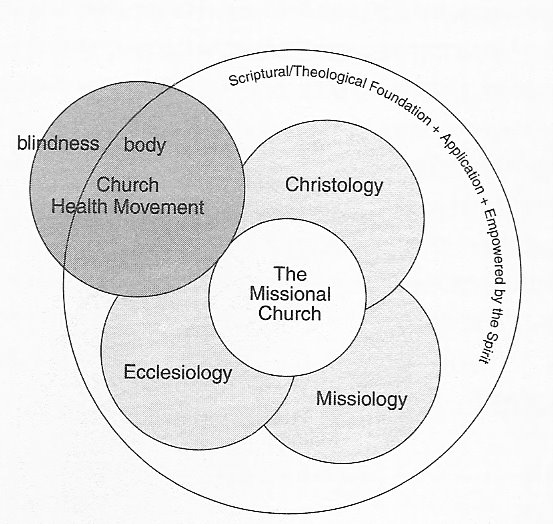
The next diagram is the Church Health movement of the 1990's. "This movement centered on how the church body was related to Christ, and what was the best form of church (ecclesiology) in order for the church to be healthy." The problem with this movement was that "this inward focus resulted in blindness to the community, blindness to other races, and blindness to other approaches" (p. 55).


You can see in the diagram that "church health" focuses on christology and ecclesiology, but not missiology, so it also isn't considered missional.

Now we come to the third model, which Stetzer and Putnam suggest represents Barna's "revolutionaries." In this diagram, you can see that there is a focus on christology and missiology, but not much in the way of ecclesiology. You will, however, notice that there is some overlap with the missional church. Here's that diagram:


Stetzer and Putnam seem to suggest two things. The first is that these "revolutionaries" have the best shot so far of being a truly missional church (demonstrated by the overlap in the diagram). Secondly, however, they also run the risk of having "an undeveloped idea of what the church is--as described by the Scripture, not by the modern notion of church" (p. 57). The danger is syncretism.

I don't know... I haven't explored this enough to know yet if I agree or not. I'm excited about the new things that are going on with the church. My friend D.G.'s (who I think is a revolutionary) organic gatherings are exactly what some people need in order to find community and a connection with God.

I think we need to keep pushing and discovering new ways of doing church, but Stetzer and Putnam offer a thoughtful reminder to make sure we have a healthy ecclesiology as we explore this revolution.

10.22.2006

Reforming, not Reformed

Ok, I promise. No more griping about the design of Velvet Elvis. I've got some real comments about it now.

I know this didn't come across in my other post (y'know, the one where I complained the whole time), but I really do like Rob's Bell's ideas. They resonate with me a lot.

In fact, right in the introduction of the book (although he calls it a "welcome" rather than an introduction; but I'm not complaining--really!) he says something that's been floating in around in my head for the past year or so. Here's what he says:

...Luther's contemporaries used a very specific word for this endless, absolutely necessary process of change and growth. They didn't use the word reformed; they used the word reforming. This distinction is crucial. They knew that they and others hadn't gotten it perfect forever. They knew that the things they said and did and wrote and decided would need to be revisited. Rethought. Reworked. [Rob's italics]
Right on, Rob!!

As a Presbyterian, my denomination prides itself in being Christians "in the Reformed tradition." In doing church "in the Reformed tradition." In worshiping "in the Reformed tradition."

But why are we stuck in this tradition that is now 500 years old? Yes, there absolutely are things to be valued in this tradition. But, as Bell says, the Reformers were in process--the process of reforming.

Like the Reformers, I don't like to say about myself that I'm Reformed, but that I'm Reforming. Please hear me on this. This doesn't mean that I think we ought to change the essentials of our faith--and I don't think that's what the Reformers meant, either. But we continue to reform ourselves and we continue to reform the church. And as we reform ourselves and the church we become more and more conformed to the image of Christ.

And hopefully this reforming self and this reforming church will more and more be able to connect with our culture and help people connect with God.

10.19.2006

Is Rob Bell real?

Sometimes I think I'm becoming too cynical. Here's my problem. I'm an INFP according to Myers-Briggs, and one of my things is that I place a high value on authenticity. So, it frustrates me when I feel like someone is being artificial.

So, I'm reading this book right now called Velvet Elvis by Rob Bell, the pastor of Mars Hill Bible Church in Grand Rapids, Michigan. My friend, Ted, is also reading the book and has posted some of his thoughts on it (here and here) over on his blog, StragglingBand. Ted asks the question, "Is questioning what you believe healthy?" He raises some thoughts worth considering....

But before I can talk about that, I just have to get this off my chest.

I just think the book design is a little over the top. I mean, look at the front cover--plain matte white with the title Velvet Elvis in small orange letters written sideways. It's also got Rob's name and the subtitle written sideways with two little "plus signs" added for aesthetic effect. It's like it's screaming out, "Look at me! I'm different!"

And what's with the bright orange pages at the front of each chapter? And what's with the chapters being called movements, and not just calling them chapters?

Don't get me wrong. I think Rob is a great thinker. I like listening to his sermons. I think his Nooma videos are awesome. I like being challenged by his ideas.

But, I don't know... I just feel like Rob is trying to be cool. Listen, it's just a book! Words on paper. Yeah, yeah, the medium is the message and all that. And believe me, I value good graphic design.

But it just feels fake to me. It feels like he's trying too hard to be "relevant" or "postmodern" or "hip" or whatever....

My cynicism is flowing right now. Sorry...

Anyway, I really do have something more significant than this to say about the book, but I just had to get this off my chest first.

10.02.2006

Punk Theology

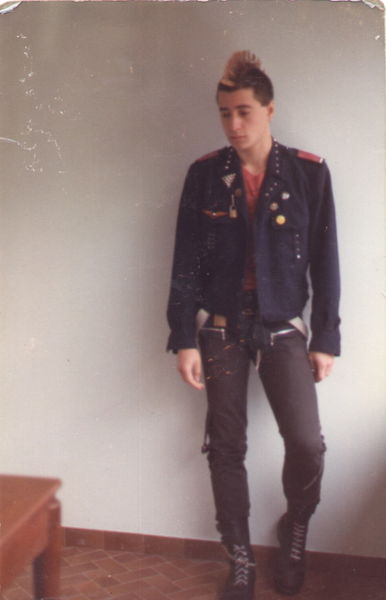
Just found a new blog called Never Mind the Bibles: A Theology of Punk. It seems to be a book in progress (that, I guess, may or may not end up published on paper), but it looks pretty interesting. Haven't read the whole thing yet, but I've gotten through enough of it that I thought some of you out there might be interested in it.

Let me know what you guys think.