10.27.2006
Attention Blogging Pastors
Just something quick. Brian Bailey, who just finished writing The Blogging Church (due out in January), is keeping a list of pastors who blog. If you're a blogging pastor, you can get on the list by e-mailing Brian (his e-mail address is at the top of the page).

10.25.2006
The Missional Matrix
 So, I'm reading Breaking the Missional Code by Ed Stetzer and David Putnam right now (yeah, I'm reading Velvet Elvis, too; and believe it or not, I'm also reading Olympos, some good sci-fi by Dan Simmons before bedtime each night!) and the book makes some pretty interesting observations, including some thoughts regarding George Barna's "revolutionaries."
I haven't read Barna's book, but I'm going to the Revolution Conference with D.G. Hollums next week, so I'm curious to see what I learn there and how it compares to Stetzer and Putnam's analysis.
Here's their analysis in brief. I'm including the diagrams from the book which will hopefully help keep this as clear as possible.
First of all, for a church to be truly missional, it has to include a healthy balance of three things: christology (Who is Jesus and what has he sent us to do?), ecclesiology (What expression of a NT church would be most appropriate in this context?), and missiology (What forms and strategies should we use to most effectively expand the kingdom where we are sent?). This is the "The Missional Matrix." Here's their diagram:
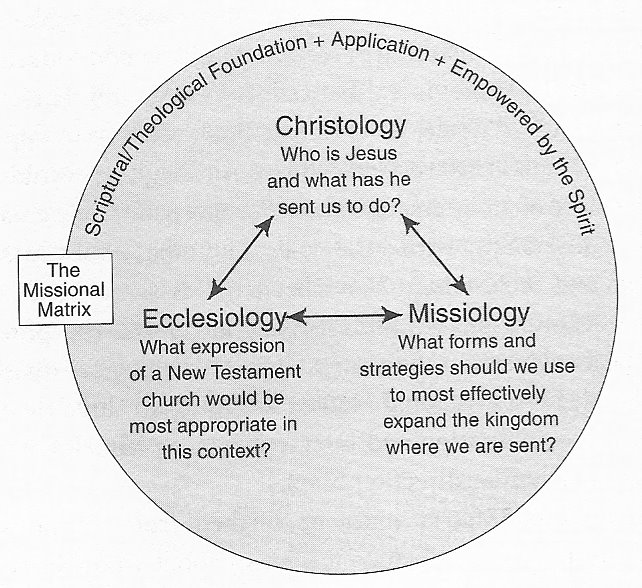
This is the starting point for understanding their next three diagrams. Each of these diagrams shows what they consider to be the truly missional church in the center with an equal emphasis on the three parts of the missional matrix.
The first model they demonstrate is the Church Growth movement of the 1960's, 70's, and 80's. The weakness of the church growth movement (which began with Donald MacGavran and continued with Peter Wagner, both of whom were at Fuller Seminary, my alma mater) was that it soon "sank into a church methods focus, many times without a foundation in scriptural truth. Thus, it strayed slightly outside of scriptural foundation and application" (p. 54). It's the typical "use this megachurch's methods and see phenomenal growth in your (vastly different) setting!" Usually didn't work. Here's that diagram:

The problem you can see in this diagram is that it overlaps with ecclesiology and missiology, but since it doesn't have a focus on christology, it can't be called a missional church.
The next diagram is the Church Health movement of the 1990's. "This movement centered on how the church body was related to Christ, and what was the best form of church (ecclesiology) in order for the church to be healthy." The problem with this movement was that "this inward focus resulted in blindness to the community, blindness to other races, and blindness to other approaches" (p. 55).
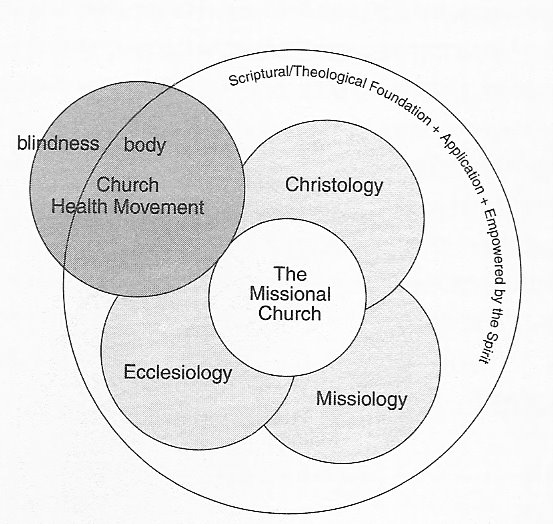
You can see in the diagram that "church health" focuses on christology and ecclesiology, but not missiology, so it also isn't considered missional.
Now we come to the third model, which Stetzer and Putnam suggest represents Barna's "revolutionaries." In this diagram, you can see that there is a focus on christology and missiology, but not much in the way of ecclesiology. You will, however, notice that there is some overlap with the missional church. Here's that diagram:

Stetzer and Putnam seem to suggest two things. The first is that these "revolutionaries" have the best shot so far of being a truly missional church (demonstrated by the overlap in the diagram). Secondly, however, they also run the risk of having "an undeveloped idea of what the church is--as described by the Scripture, not by the modern notion of church" (p. 57). The danger is syncretism.
I don't know... I haven't explored this enough to know yet if I agree or not. I'm excited about the new things that are going on with the church. My friend D.G.'s (who I think is a revolutionary) organic gatherings are exactly what some people need in order to find community and a connection with God.
I think we need to keep pushing and discovering new ways of doing church, but Stetzer and Putnam offer a thoughtful reminder to make sure we have a healthy ecclesiology as we explore this revolution.
10.24.2006
Why do people go to church?
Ted Gillgrist over at StragglingBand has just posted what, in my opinion, is one of the best things I've read on what really makes people want to go to church. Check out his post here.
10.22.2006
Reforming, not Reformed
 Ok, I promise. No more griping about the design of Velvet Elvis. I've got some real comments about it now.
I know this didn't come across in my other post (y'know, the one where I complained the whole time), but I really do like Rob's Bell's ideas. They resonate with me a lot.
In fact, right in the introduction of the book (although he calls it a "welcome" rather than an introduction; but I'm not complaining--really!) he says something that's been floating in around in my head for the past year or so. Here's what he says:
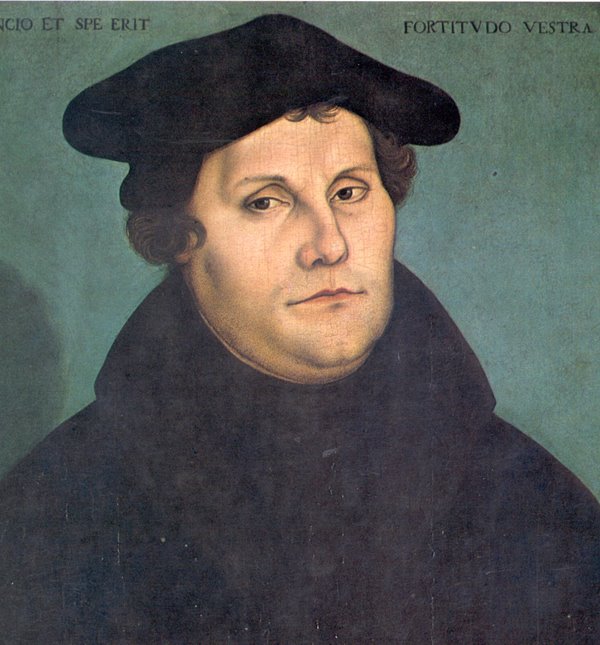
...Luther's contemporaries used a very specific word for this endless, absolutely necessary process of change and growth. They didn't use the word reformed; they used the word reforming. This distinction is crucial. They knew that they and others hadn't gotten it perfect forever. They knew that the things they said and did and wrote and decided would need to be revisited. Rethought. Reworked. [Rob's italics]Right on, Rob!!
As a Presbyterian, my denomination prides itself in being Christians "in the Reformed tradition." In doing church "in the Reformed tradition." In worshiping "in the Reformed tradition."
But why are we stuck in this tradition that is now 500 years old? Yes, there absolutely are things to be valued in this tradition. But, as Bell says, the Reformers were in process--the process of reforming.
Like the Reformers, I don't like to say about myself that I'm Reformed, but that I'm Reforming. Please hear me on this. This doesn't mean that I think we ought to change the essentials of our faith--and I don't think that's what the Reformers meant, either. But we continue to reform ourselves and we continue to reform the church. And as we reform ourselves and the church we become more and more conformed to the image of Christ.
And hopefully this reforming self and this reforming church will more and more be able to connect with our culture and help people connect with God.
10.20.2006
More Bell
 Ok, full disclosure here. I just listened to one of Rob Bell's sermons on their website and I gotta say--it was really good! I may think the way he designed his book is kinda lame, but I do like his preaching!
10.19.2006
Is Rob Bell real?
 Sometimes I think I'm becoming too cynical. Here's my problem. I'm an INFP according to Myers-Briggs, and one of my things is that I place a high value on authenticity. So, it frustrates me when I feel like someone is being artificial.
So, I'm reading this book right now called Velvet Elvis by Rob Bell, the pastor of Mars Hill Bible Church in Grand Rapids, Michigan. My friend, Ted, is also reading the book and has posted some of his thoughts on it (here and here) over on his blog, StragglingBand. Ted asks the question, "Is questioning what you believe healthy?" He raises some thoughts worth considering....
But before I can talk about that, I just have to get this off my chest.
I just think the book design is a little over the top. I mean, look at the front cover--plain matte
 white with the title Velvet Elvis in small orange letters written sideways. It's also got Rob's name and the subtitle written sideways with two little "plus signs" added for aesthetic effect. It's like it's screaming out, "Look at me! I'm different!"
And what's with the bright orange pages at the front of each chapter? And what's with the chapters being called movements, and not just calling them chapters?
Don't get me wrong. I think Rob is a great thinker. I like listening to his sermons. I think his Nooma videos are awesome. I like being challenged by his ideas.
But, I don't know... I just feel like Rob is trying to be cool. Listen, it's just a book! Words on paper. Yeah, yeah, the medium is the message and all that. And believe me, I value good graphic design.
But it just feels fake to me. It feels like he's trying too hard to be "relevant" or "postmodern" or "hip" or whatever....
My cynicism is flowing right now. Sorry...
Anyway, I really do have something more significant than this to say about the book, but I just had to get this off my chest first.
10.13.2006
U2 + Apple = Holy Cow!
 Brian Bailey, who is in the process of writing a book called The Blogging Church, (see my earlier post) has an amazing announcement about U2 and Apple. One note of warning: if you start to read this, be sure to read the whole thing...
Subscribe to:
Posts (Atom)
