Showing posts with label emerging. Show all posts
Showing posts with label emerging. Show all posts
2.12.2007
Article on Mainline Emergent/s Conference
Adam Walker Cleaveland at Presbymergent just posted a link to an article in The Presbyterian Outlook about the Mainline Emergent/s Conference. Just FYI, it sounds like the conference involved more than just Presbyterians, but since the Outlook is a Presbyterian publication, it tends to focus on how Presbyterians responded to the conference. Anyway, the article is posted here as a pdf.

2.08.2007
Presbymergent or Presbymerging?
I just posted a brief article on Presbymergent titled, "Presbymergent or Presbymerging?" Check it out here if you're interested.
2.07.2007
Seeker Church vs. Emerging Church
 Kyle posted some comments/questions about my Launch Conference notes that I think deserve being addressed.
First of all, I need to confess that I definitely don't have all the answers. I never have and I don't think I ever will.
I'm drawn to the postmodern/emerging/incarnational approach to ministry. And I wish I could say I was 100% there because I think that this movement really is meeting the needs of people in my generation.
At the same time, I've begun to discover that there's still value in some of the older approaches to ministry (funny--by older, I mean 25 years...). There are millions of people in this country who would get a little freaked out by the idea of becoming part of an "intentional community." I, personally, understand the value of that kind of community, but for many people when someone says "Community," what they hear is "Commune."
Anyway, I say this because over the last year or so I've realized that it's not that "seeker" is "out" and "emerging" is "in." Both are "in," depending on the context and the culture that a particular church is trying to reach. Heck, even old-school, mainline, traditional is "in" for some people.
So, let me address Kyle's comments/questions:
1. Yes, the Launch Conference definitely came from a "purpose-driven, seeker-attractive" perspective. In fact, Nelson Searcy was open about the fact that he used to work at Saddleback with Rick Warren and continues to use the purpose-driven aproach with The Journey Church.
2. I, personally, am not planning on planting a church in Northern Kentucky. I am considering planting a church in another metropolitan area in another part of the country. But that's still up in the air. I'm also in talks with an established church. I had three reasons for attending the conference: 1) Learn about church-planting (in case that's what I do), 2) learn some things that will hopefully be transferable to an established church situation (in case that's what I do), and 3) get some clarity on whether or not I'm called to church-planting (which I'm still wrestling with).
3. It's true that there will probably be a different kind of spirituality in a "seeker" type of church than in an "intentional community" kind of church. But I think one of the reasons is because of the people that each type of church attracts. Regardless of what you believe, "intentional community" kinds of churches attract a certain kind of person. Likewise, "seeker" kinds of churches attract a different kind of person. And regarding a "core" vs. a "launch team," one of my upcoming posts will explain why they suggest going with a launch team rather than a core.
Like I said, I'm still on a journey. I'm still trying to figure things out. And I think that's why I still like the word "stretchychurch." The church fits all kinds--emerging, seeker, traditional, mainline, protestant, Catholic, conservative, liberal, fundamentalist, evangelical, etc., etc., etc.
The question isn't, "Are they doing it right?" The question is, "Are they helping people become followers of Jesus?"
12.31.2006
Velvet Elvis Complete
 Well, I finally finished reading Velvet Elvis. I know... some of you are wondering, "What took you so long?! The book's not that long!"
Ok, I was supposed to be reading it together with some friends who shall remain nameless (Chad and Wes), but whenever we got together to discuss the book, we never really discussed the book.
Don't get me wrong. We had great conversations--and many of them were deeply theological--they just didn't focus specifically on the book. So, I took my time reading the book, waiting to see if we were gonna discuss the chapters we had read.
Never happened. Or more accurately, rarely happened.
I got to the point where I just wanted to finish the book, and that's what I did a couple days ago.
I know that I've been a little hard on Rob Bell in the past (mostly in terms of how he comes across), but I have to admit that his theology really resonates with me. I've been listening to his sermons on the Mars Hill website and I'm always enlightened and/or convicted by the time I'm done listening.
While I don't necessarily want to be another Rob Bell, I do hope and pray that my own faith would continue to grow in the direction that God seems to be taking it--namely in the direction of truly living out the Gospel of Jesus not only in word, but also in deed. That is, in the way that I live my life in the world as a follower of Jesus. (Check out Ted's post for more of this in regard to Rob Bell.)
Thanks, Rob, for challenging me in that direction.
11.07.2006
Pastors who Drink and Cuss
 I've got a lot to share about my time at the Revolution Conference, so I kinda feel like I need to be selective in what I talk about--just so don't drone on forever. If you want to know about the specifics of the conference, the main sessions, the seminars, and so forth, you can look at the Revolution Conference Blog.
One of the things I noticed was that it seems like a lot of people who are a part of this "revolution" that George Barna describes in his book--it seems like they come from a very fundamentalist/conservative evangelical background. As a result, a lot of their interest in this "revolutionary" kind of church is a reaction against a theology and spirituality that was strict, pushy, judgmental, narrow-minded, etc., etc., etc.
This was not my background. I know I complain a fair amount about my denomination, but as Presbyterians, my family was not particularly fundamentalist and I'm grateful for that. We did fall on the conservative side of Presbyterianism--but the even conservative Presbyterians look pretty liberal to a lot of other Christians.
So, my interest in the "revolution" has nothing to do with my background. It does have everything to do with finding more effective ways of helping people connect with God in a way that is deep, meaningful, and lifelong (I realize that this is also what drives those with a fundamentalist background).
The problem with a person's interest in the "revolution" being reactionary is that the pendulum can swing too far.
This is why I appreciate Brian McLaren's comments on this topic. I know that Brian's latest books have been fairly controversial, but at this conference Brian provided a source of groundedness and centeredness.
Here's a paraphrase of what McLaren said in one of the question-and-answer times:
A lot of times, when we react to something in our past we have a tendency to go too far in the other direction. Sometimes, because our past taught us not to drink, we start drinking more and more. But when we start drinking too much alcohol we become dangerous. Sometimes we react to stringent rules on sexuality by going too far in the other direction. But then we start damaging people sexually.... What the world doesn't need is a bunch of pastors who drink and cuss a lot.I was so happy to hear him say this! There were times when I felt a little out of place with the crowd at this conference, but hearing Brian McLaren provide wisdom and act as a guiding light for all of us gave me great hope for the future of this "revolution."
11.04.2006
I've got a pain in my...
 My butt hurts.
You think I’m kidding, don’t you? I’m serious. I’ve been sitting so much these last two days that my butt is sore!
Here’s a timeline of my sitting over these two days:
Thursday, November 2, 2006
- 6:30-8:00 a.m. – Sit in D.G.’s car to drive to the airport in Louisville.
- 8:00-9:30 a.m. – Sit in the waiting area at the Louisville Airport.
- 9:30 (ET) - 11:05 a.m. (CT) – Sit in an airplane (this is actually 2½ hours).
- 11:05-12:30 p.m. - Sit at Chili’s Too for lunch at the Houston Airport.
- 12:30 (ET) - 3:30 p.m. (PT) – Sit in an airplane (this is actually 5 hours).
- 4:30-5:30 p.m. – Sit on a bus to downtown Seattle (after picking up luggage and rental car).
- 6:00-7:00 p.m. – Sit at hole-in-the-wall seafood place for dinner (after seeing the flying fish and the original Starbucks at the Pike Place Market).
- 7:30-8:00 p.m. – Sit on a bus back to the airport.
- 8:00-8:30 p.m. – Sit in the car to our hotel.
Friday, November 3, 2006
- 9:00-9:45 a.m. – Sit and listen to George Barna and Brian McLaren talk about the Revolution.
- 10:45-12:00 p.m. – Sit and listen to Rich and Rose Swetson talk about “Missional Pastor Revolutionaries.”
- 12:00-1:00 p.m. – Sit at lunch with D.G. at Peking Chinese Restaurant.
- 1:00-3:25 p.m. – Sit and listen to Barna and McLaren again.
- 3:25- 4:00 p.m.- Sit and listen to Christine Wicker talk about her journey as a non-Christian.
- 4:00-5:00 p.m. – Sit and listen to Sunil Sardar talk about the justice revolution in India.
- 5:00-7:00 p.m. – Sit at dinner with a bunch of other bloggers at the Fire Creek Grill.
- 7:00-9:00 p.m. – Listen to McLaren and others again.
- 10:00-11:00 p.m. – Sit in the bar/restaurant in the hotel and talk with D.G. and Todd Hiestand.
- 11:00-right now – Sit and write this blog!
Like I said. My butt hurts.
There’s a lot more I could say right now, but I’ll save that for next time. Let me just say that the Revolution Conference is great! I’m meeting some really great people and having an awesome time hanging out with D.G.!
And speaking of D.G., check out his blog for some pictures and other stuff about what we did.
11.01.2006
Revolution, here we come!!
 Just got off the phone with D.G. to finalize our travel plans for tomorrow morning. He'll be at my place to pick me up at 6:30 a.m. (woo-hoo! and I still have to pack!). And then we're off to Seattle for the Revolution Conference!
I'm really excited about this trip several reasons:
- I get to hang out with D.G. for four days!
- I've never been to Seattle, so that'll be fun!
- I get to meet a bunch of other ministry creatives!
- I get to see fish-throwing!
- I get to see the place that has changed the face of a generation--the original Starbucks!
10.25.2006
The Missional Matrix
 So, I'm reading Breaking the Missional Code by Ed Stetzer and David Putnam right now (yeah, I'm reading Velvet Elvis, too; and believe it or not, I'm also reading Olympos, some good sci-fi by Dan Simmons before bedtime each night!) and the book makes some pretty interesting observations, including some thoughts regarding George Barna's "revolutionaries."
I haven't read Barna's book, but I'm going to the Revolution Conference with D.G. Hollums next week, so I'm curious to see what I learn there and how it compares to Stetzer and Putnam's analysis.
Here's their analysis in brief. I'm including the diagrams from the book which will hopefully help keep this as clear as possible.
First of all, for a church to be truly missional, it has to include a healthy balance of three things: christology (Who is Jesus and what has he sent us to do?), ecclesiology (What expression of a NT church would be most appropriate in this context?), and missiology (What forms and strategies should we use to most effectively expand the kingdom where we are sent?). This is the "The Missional Matrix." Here's their diagram:
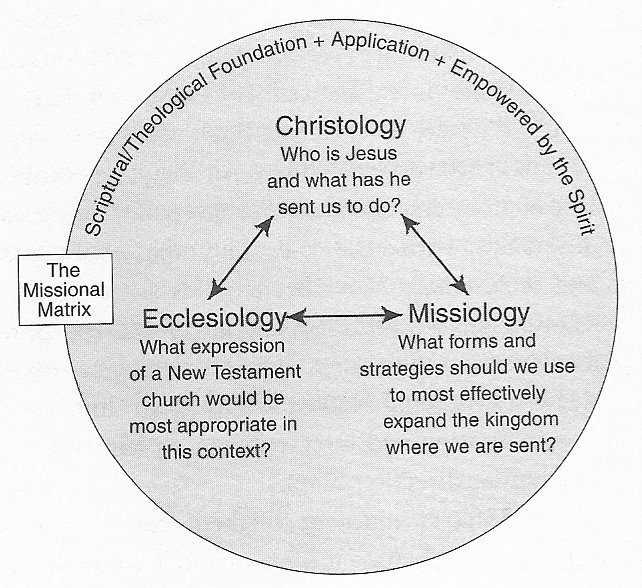
This is the starting point for understanding their next three diagrams. Each of these diagrams shows what they consider to be the truly missional church in the center with an equal emphasis on the three parts of the missional matrix.
The first model they demonstrate is the Church Growth movement of the 1960's, 70's, and 80's. The weakness of the church growth movement (which began with Donald MacGavran and continued with Peter Wagner, both of whom were at Fuller Seminary, my alma mater) was that it soon "sank into a church methods focus, many times without a foundation in scriptural truth. Thus, it strayed slightly outside of scriptural foundation and application" (p. 54). It's the typical "use this megachurch's methods and see phenomenal growth in your (vastly different) setting!" Usually didn't work. Here's that diagram:

The problem you can see in this diagram is that it overlaps with ecclesiology and missiology, but since it doesn't have a focus on christology, it can't be called a missional church.
The next diagram is the Church Health movement of the 1990's. "This movement centered on how the church body was related to Christ, and what was the best form of church (ecclesiology) in order for the church to be healthy." The problem with this movement was that "this inward focus resulted in blindness to the community, blindness to other races, and blindness to other approaches" (p. 55).
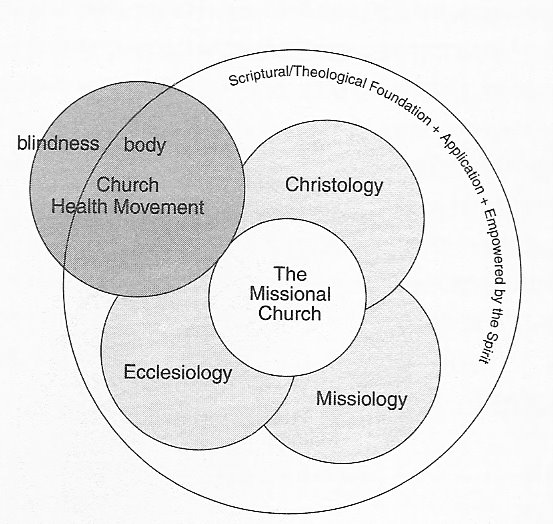
You can see in the diagram that "church health" focuses on christology and ecclesiology, but not missiology, so it also isn't considered missional.
Now we come to the third model, which Stetzer and Putnam suggest represents Barna's "revolutionaries." In this diagram, you can see that there is a focus on christology and missiology, but not much in the way of ecclesiology. You will, however, notice that there is some overlap with the missional church. Here's that diagram:

Stetzer and Putnam seem to suggest two things. The first is that these "revolutionaries" have the best shot so far of being a truly missional church (demonstrated by the overlap in the diagram). Secondly, however, they also run the risk of having "an undeveloped idea of what the church is--as described by the Scripture, not by the modern notion of church" (p. 57). The danger is syncretism.
I don't know... I haven't explored this enough to know yet if I agree or not. I'm excited about the new things that are going on with the church. My friend D.G.'s (who I think is a revolutionary) organic gatherings are exactly what some people need in order to find community and a connection with God.
I think we need to keep pushing and discovering new ways of doing church, but Stetzer and Putnam offer a thoughtful reminder to make sure we have a healthy ecclesiology as we explore this revolution.
10.22.2006
Reforming, not Reformed
 Ok, I promise. No more griping about the design of Velvet Elvis. I've got some real comments about it now.
I know this didn't come across in my other post (y'know, the one where I complained the whole time), but I really do like Rob's Bell's ideas. They resonate with me a lot.
In fact, right in the introduction of the book (although he calls it a "welcome" rather than an introduction; but I'm not complaining--really!) he says something that's been floating in around in my head for the past year or so. Here's what he says:
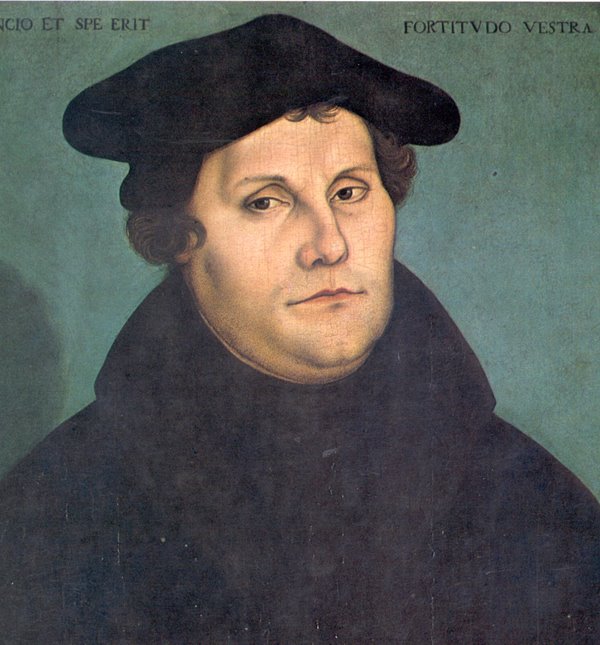
...Luther's contemporaries used a very specific word for this endless, absolutely necessary process of change and growth. They didn't use the word reformed; they used the word reforming. This distinction is crucial. They knew that they and others hadn't gotten it perfect forever. They knew that the things they said and did and wrote and decided would need to be revisited. Rethought. Reworked. [Rob's italics]Right on, Rob!!
As a Presbyterian, my denomination prides itself in being Christians "in the Reformed tradition." In doing church "in the Reformed tradition." In worshiping "in the Reformed tradition."
But why are we stuck in this tradition that is now 500 years old? Yes, there absolutely are things to be valued in this tradition. But, as Bell says, the Reformers were in process--the process of reforming.
Like the Reformers, I don't like to say about myself that I'm Reformed, but that I'm Reforming. Please hear me on this. This doesn't mean that I think we ought to change the essentials of our faith--and I don't think that's what the Reformers meant, either. But we continue to reform ourselves and we continue to reform the church. And as we reform ourselves and the church we become more and more conformed to the image of Christ.
And hopefully this reforming self and this reforming church will more and more be able to connect with our culture and help people connect with God.
Subscribe to:
Posts (Atom)
